Designing Effective Loyalty Cards for Orange County Cafes
For an Orange County cafe, a loyalty card is often the difference between a one-time visitor and a regular who orders the same oat milk latte every Tuesday. The design of that card—its size, material, and visual hierarchy—determines whether it lives in a wallet for months or gets tossed in the trash bin by the register. Effective loyalty card design focuses on durability, clear earning mechanics, and brand recall that fits the local Irvine and OC market.
Why Physical Loyalty Cards Still Work for OC Cafes
Digital apps dominate national chains, but independent cafes in places like Irvine, Costa Mesa, and Laguna Beach still see strong returns from physical punch cards. The reason is behavioral: a physical card sitting in a wallet creates a tangible commitment. When a customer sees the card, they remember they are three punches away from a free drink. That reminder drives repeat visits in a way that a buried app notification often does not.
Physical cards also cost pennies per unit when printed in bulk. For a cafe testing loyalty for the first time, a run of 1,000 cards is a low-risk experiment. You avoid app development costs, monthly software fees, and the friction of asking customers to download something. The card itself becomes a mini-billboard for your brand every time the customer opens their wallet.
Card Size and Material: What Survives a Pocket or Purse
The standard credit card size (3.37 x 2.125 inches) remains the safest choice. It fits in the card slot of a wallet without sticking out or bending. Anything smaller gets lost; anything larger gets left at home. For cafes that want a slightly different feel, a vertical orientation still works within the same dimensions, but horizontal is more familiar for punch mechanics.
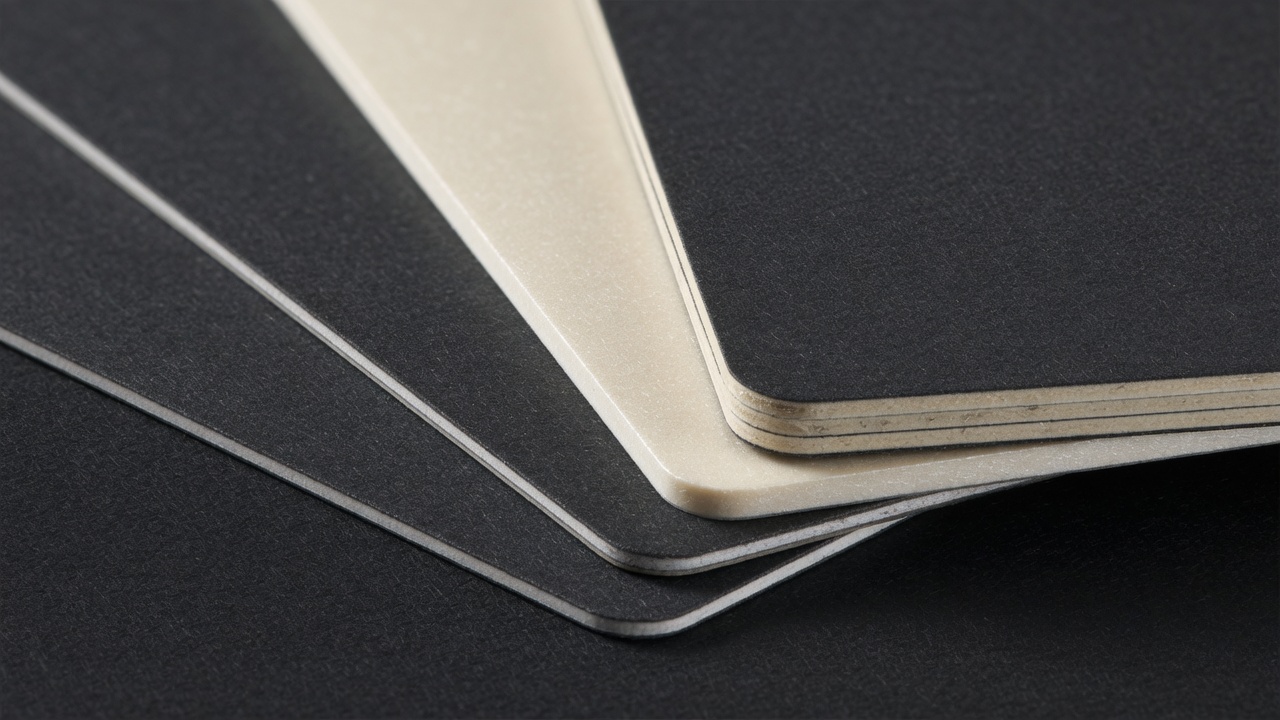
Material matters more than most cafe owners expect. Standard 14pt or 16pt cardstock with a matte finish works for basic punch cards, but it will show wear within a few weeks. Coins and keys scratch it, and coffee spills stain it. Consider these options:
- Plastic cards (PVC): These last for years, resist moisture, and feel premium. They cost more upfront but work well for cafes that want a permanent rewards program rather than a promotional test.
- Thick cardstock with aqueous coating: A middle-ground option. It holds up for 2–3 months of regular use, which is usually enough time for a customer to complete a 10-punch card.
- Recycled paper stock: Good for eco-conscious brands, but you must accept that these cards will wrinkle and tear. They signal sustainability over durability.
If you are printing loyalty cards for a cafe in Irvine, the local climate matters too. Humidity and heat can warp low-quality paper. A plastic or coated card avoids the warping problem entirely.
Visual Design: Branding That Works at a Glance
Your loyalty card is a mini billboard. The customer will look at it for about two seconds each time they pull it out. That means your logo, cafe name, and punch area need to be instantly readable. Do not cram the card with menu items, social media handles, and a map. That is a recipe for visual noise.
Follow a simple hierarchy:
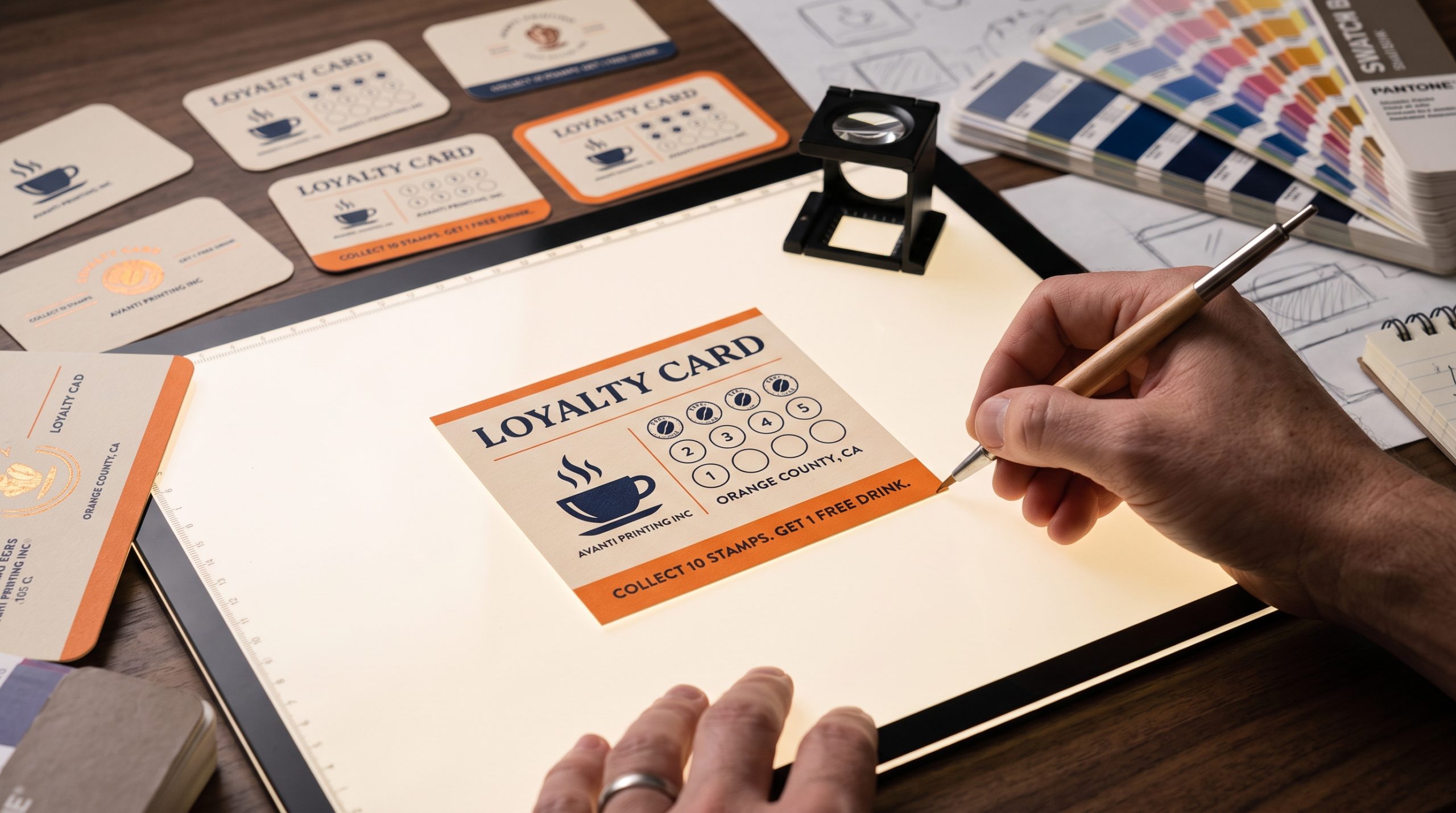
- Top 30% of the card: Your logo and cafe name. This must be legible at arm’s length.
- Middle 40%: The punch grid or reward tracking area. This needs clear, numbered circles or boxes.
- Bottom 30%: The reward description (“Buy 10, Get 1 Free”) and your website or Instagram handle.
Color choice matters. If your cafe has a distinctive brand color—say, a deep teal or a warm terracotta—use it as the background. But keep the punch area high-contrast. A dark card with black punch circles is a usability failure. The customer should be able to see at a glance how many punches they have accumulated.
Punch Mechanics: Designing for Clarity, Not Confusion
The biggest mistake in loyalty card design is unclear earning rules. If the customer has to ask the barista how the card works, the design has failed. The card should answer the basic questions on its face: What do I buy to get a punch? How many punches do I need? What do I get when I reach the goal?
Here are the common punch structures and how to design for each:
| Structure | Design Implication | Best For |
|---|---|---|
| 10 punches, 1 free drink | Numbered circles 1–10 in a 2×5 or 5×2 grid | Most cafes; simple and proven |
| 6 punches, 1 free pastry | Larger circles, fewer of them; easier to fill | High-frequency, low-ticket items |
| Stamp-style (no numbers) | Blank squares or shapes; barista stamps manually | Brands with custom-shaped stamps |
| Digital-linked QR card | QR code plus a single punch slot; tracks via phone | Cafes transitioning to digital |
For the 10-punch grid, make the circles at least 0.25 inches in diameter. Smaller than that, and the punch tool tears the paper instead of making a clean hole. If you are using a stamp instead of a punch tool, ensure the ink pad color contrasts with the card background. A dark green stamp on a brown card is nearly invisible.
Choosing Between Punches and Stamps
Punches create holes; stamps create ink marks. Punches are faster for baristas and harder to fake, but they weaken the card structure over time. Ten holes in a small card can make it flimsy. Stamps are gentler on the card but require a clean ink pad and a steady hand. If you go with stamps, budget for replacing the ink pads monthly—dry pads create illegible marks that frustrate customers.
Designing for the “Almost There” Moment
Effective loyalty cards exploit the sunk-cost effect. When a customer is at 8 out of 10 punches, they are far more likely to return than when they are at 2 out of 10. Design your card to make progress visible. Numbered circles do this naturally. Some cafes add a visual cue like a coffee cup graphic that fills up as punches accumulate. That visual progress bar is a subtle psychological nudge that works.
Local Considerations for Orange County Cafes
Orange County has a distinct cafe culture. Customers in Irvine, Tustin, and Newport Beach are accustomed to high-quality coffee and expect a certain level of polish in branding. A poorly printed, flimsy card reflects poorly on the cafe. Conversely, a sturdy card with a thoughtful design signals that the cafe takes its business seriously.
Local demographics matter for the reward structure itself. In Irvine, where many customers work in tech or biotech, a digital option might be appreciated. You can print a card with a QR code that links to a digital punch tracker, bridging the physical and digital worlds. In beach cities like Huntington Beach or San Clemente, a purely physical card with a surf-inspired design might resonate more. Know your specific neighborhood.
Another local angle: partnership cards. A cafe in Costa Mesa might partner with a nearby bakery or bookstore to create a shared loyalty card. This requires more complex design—two logos, two punch grids—but it expands your reach. Just ensure the design stays clean. A shared card with two competing reward systems can confuse customers.
Printing Costs and Quantity: What to Expect
Pricing for loyalty cards in Orange County varies by material, quantity, and finishing. A standard 14pt cardstock card with full-color printing runs roughly $0.10 to $0.25 per card for quantities of 1,000 or more. Plastic PVC cards are more expensive, typically $0.50 to $1.00 per card depending on thickness and whether you add features like rounded corners or a matte laminate.
Do not order the minimum quantity. Cafes lose cards, customers lose cards, and you will want extras for new customers. A 2,000-card run is a reasonable starting point for a busy cafe. The per-unit cost drops significantly at this volume, and you will not run out during a promotional push.
When you work with a local printer like Business Cards Irvine, you can also ask for a physical proof before the full run. This is worth doing. A proof lets you test the cardstock thickness, check the color accuracy of your logo, and confirm that the punch circles are sized correctly. Digital proofs on a screen do not tell you how the card feels in hand.
Turnaround Times and Reordering
Most local print shops in Irvine offer 3–5 business day turnaround for standard cardstock loyalty cards. Plastic cards take longer, sometimes 7–10 business days, because they require a different printing process. Plan your reorder before you run out. A cafe that runs out of loyalty cards for two weeks loses momentum; regulars notice, and the habit breaks.
Common Design Mistakes to Avoid
Even with a solid concept, small design errors can undermine the card’s effectiveness. Here are the mistakes I see most often when reviewing cafe loyalty cards:
- Too much text: If you need a paragraph to explain the rules, the card is overcomplicated. Keep it to one sentence.
- Punch areas too close to the edge: Punch tools can tear the card edge if the circles are less than 0.125 inches from the border. Give the grid breathing room.
- No expiration date: Some cafes intentionally omit expiration to build goodwill. If you do include one, print it clearly. An unclear expiration policy creates customer service headaches.
- Unreadable reward description: “Buy 10 Get 1 Free” should be in a font size of at least 8pt. Anything smaller is inaccessible to older customers.
- Ignoring the back of the card: The back is prime real estate. Use it for your story, your sourcing philosophy, or a simple map to your location. Leaving it blank is a wasted opportunity.
One more mistake: designing a card that does not match your cafe’s actual aesthetic. If your cafe is minimalist with white walls and simple typography, a loud, colorful card with gradients will feel off-brand. The card should feel like an extension of the physical space.
Measuring Success and Iterating
Once your loyalty cards are in circulation, track the numbers. How many cards do you hand out per week? How many come back completed? If you hand out 100 cards a week but only 5 come back, something is wrong. Either the reward is not compelling, the card is getting lost, or the baristas are not consistently offering the card at checkout.
Consider adding a simple tracking mechanism. Print a small batch of cards with a unique code or a different background color for each month. When customers redeem, you can see which batch they came from and estimate the average time to completion. This data tells you whether your reward structure is realistic. If most customers take three months to fill a 10-punch card, that is too long. Consider switching to a 6-punch card for a faster reward cycle.
Do not be afraid to redesign after six months. Customer feedback will tell you if the card is working. Ask regulars what they think. They will tell you if the card is too flimsy, the punch grid is confusing, or the reward is not worth the effort. Iterate based on that feedback, not on assumptions.
Frequently Asked Questions
How many punches should a loyalty card require?
For a typical cafe where the average customer visits 2–3 times per week, a 10-punch card takes about a month to complete. That is a good cadence. If your average ticket is high (over $10 per visit), a 6-punch card might be more appropriate. If your cafe is a destination spot that customers visit only occasionally, consider a 5-punch card to keep the reward within reach.
Should I offer a digital loyalty option instead of a physical card?
You can offer both, but start with physical. Physical cards have a higher completion rate for small independents because they do not require app downloads or account creation. If you later add a digital option, make sure the physical card still works. Do not force customers to switch—that breeds resentment.
Can I print loyalty cards on the same stock as business cards?
Yes, but with a caveat. Standard business card stock (14pt) is fine for a short-term punch card. However, if you want the card to last for months, upgrade to 16pt or plastic. The slightly higher cost per card is worth it when you factor in the cost of reprinting cards that fall apart prematurely. Ask your printer about the options; a local shop like Avanti Printing in Irvine (15321 Barranca Pkwy) can show you physical samples of different stocks so you can feel the difference before committing.
Visit Business Cards Irvine